Head of Product Design · Alef Education · 2018–2021
K-12 Platform, Zero to a Million
From classroom-only product to a blended learning platform — serving teachers, students, and guardians across the UAE.
Alef Education builds K-12 learning for UAE public schools.
I joined at first release and helped grow it into a full platform. My work covered two things:
- Concept design and product planning — deciding what the platform should become
- UX and UI design — designing the core features for three different audiences
Three problems shaped every decision.
- One class, many levels. Students in the same classroom are at very different stages. A single pace fails most of them.
- Quality depends on the teacher. Outcomes rely heavily on who is teaching — and UAE teacher turnover is high. Quality had to stay consistent regardless of who stands at the front.
- Motivation is low. Students weren't engaged. Learning had to become more engaging and more effective, not one at the cost of the other.
Concept Design & Product Planning
Deciding what the platform should become — and proving it with two competing concepts.
Move from classroom-only learning to blended learning.
That meant adding richer content types and self-study — without splitting the experience in two. I built two concepts to test how far to go.
Keep school and self-study as two parallel tracks.
- My Class — the teacher-led curriculum, by subject
- My Learning — third-party material the student picks up alone
- Tasks and challenges — with a mastery score that rewards practice beyond what's set
The model separates what content is from who chose it.
- Types — curriculum, practice, test, other material
- Routes in — system recommends, teacher assigns, teacher recommends, student chooses
Keeping these two axes independent is what later made mixing sources feel deliberate rather than random.
Merge school and self-study behind one shared goal.
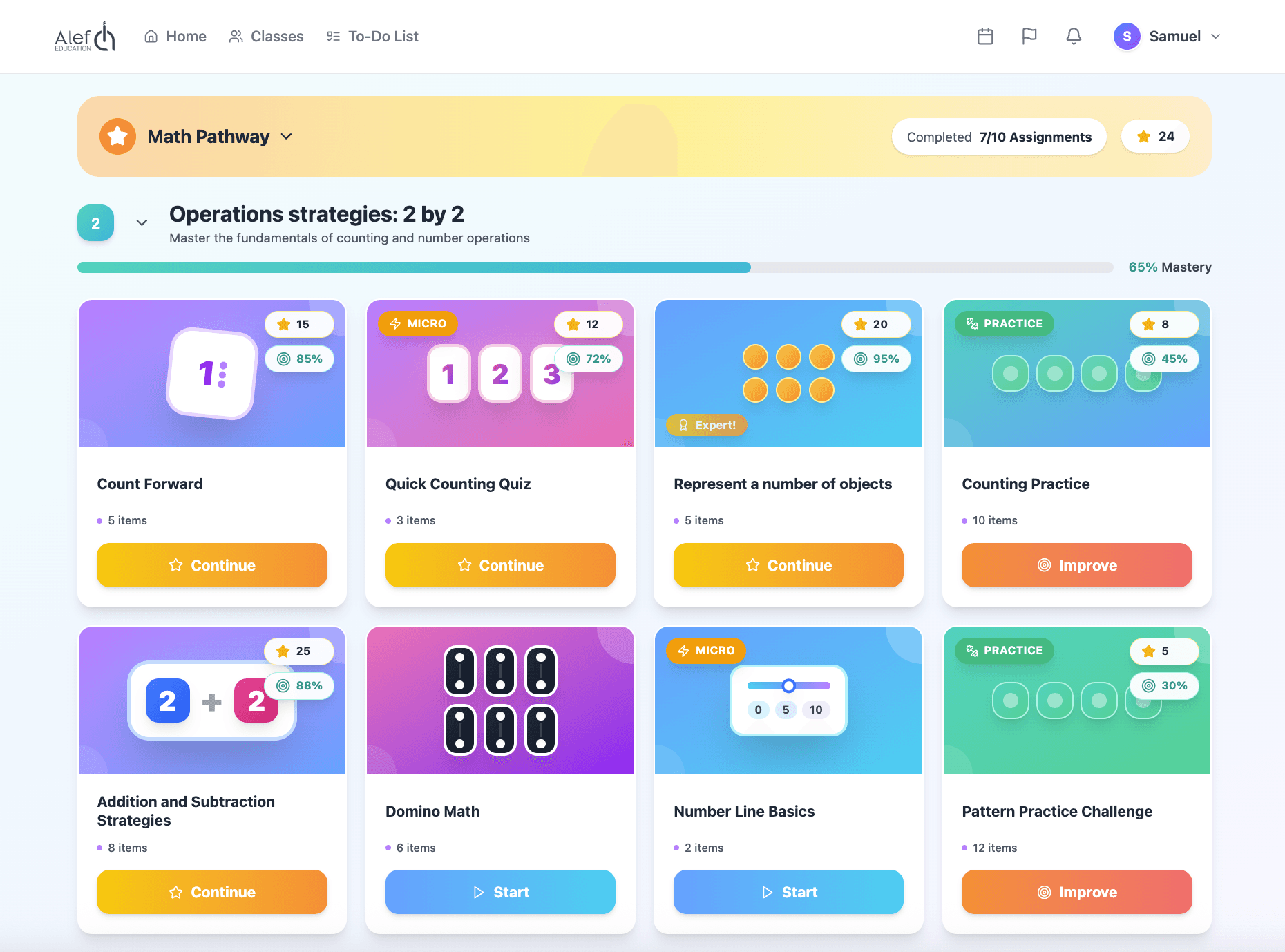
- One measure per subject — curriculum and third-party content roll into a single mastery percentage
- Gamification — levels, experience points, stars, and a character that grows with the student
This won. It answers the question a student actually asks — how am I doing in Maths? — instead of handing them two separate answers.
Gamification only works if it rewards the right thing.
Profession level is built from two separate inputs, so effort and achievement stay distinct:
- Stars — earned through recognition
- Experience — earned through mastery
The model also makes room for personal goals and 21st-century skills — including activity away from the screen.
Day-to-Day Product Design
The ongoing work: designing and shipping the platform's core features, release after release.
I led UX and UI for the platform's main features. Each audience needs something different:
- Teachers — run the class, spot problems fast
- Students — focus and momentum inside one lesson
- Guardians — clarity in a short, occasional glance
The home page answers three questions at a glance: How are my lessons doing? Am I on track? Who needs help?
- Banded performance, not scores — including an explicit no sufficient data state, so thin evidence is never read as a result
- Pacing guide by week, flagging when the class falls behind
- Struggling students named directly, with their score or how far behind they are
The result reads as a to-do list, not a report.
Compares groups within a grade instead of reporting one average — so a teacher can see which section is lagging, and on which lesson.
Filters for class, subject, and period stay pinned to the left, so the question stays visible while the answer changes.
Blended teaching means controlling what's open, to whom, and when.
Access state is the most prominent thing on every card — accessible for 25 of 30. A teacher can audit a whole trimester by scanning, without opening anything.
Sets the student against their class, not in isolation.
- Radar chart — subject performance vs class average
- Star history — what was submitted, what was awarded, in the teacher's own words
- All three attempts per lesson, next to the final assessment
Showing every attempt — not just the best — reveals whether a student is improving or guessing.
Every lesson follows the same spine: the big idea, three depths of knowledge, a last look, an exit ticket. Structure stays predictable even as content changes.
A bilingual glossary opens in place, in English and Arabic. In a bilingual classroom that matters — a student who doesn't know a word can resolve it without leaving the task.
Guardians check in briefly and irregularly. Mobile leads with comparison and recency, not depth.
- Average score — their child next to the class average, per subject
- Progress feed — newest first, grouped by day, attempt number shown
- Full attempt history on tap
A parent seeing 50%, then 65%, then 76% reads effort and improvement — not one disappointing number.
The extra space buys breadth, not more metrics.
All subjects compare against the grade average at once, and the progress feed sits beside a detail panel — so opening an item never costs a parent their place in the list.
- Zero to 1M+ students — the platform scaled from first release to over a million learners
- A clear direction — Concept 2's integrated, goal-based model became the product
- A platform, not a classroom tool — teacher, student, and guardian, for both classroom and individual learning
- Foundations that lasted — separating content type from source, and mastery from reward, gave later work a structure to build on. The AI-driven work in Alef Pathways built directly on this model.