Head of Product Design · Alef Education · 2022
Personalised Learning at 1.8M Scale
Personalised learning experiences that adapt to every student's unique pace — making learning both effective and fun.
Alef Pathways is a personalised K-12 learning platform where students progress at their own pace. I led the design vision for a product that adapts to each learner's needs across Mathematics, Science, Arabic, and English — building self-confidence and a growth mindset.
- Serve three user groups in one product — students, educators, and guardians — each with distinct needs
- Translate AI mastery measurement and recommendations into friendly, intuitive experiences
- Surface deep pedagogical methods (quantile assessment, prerequisite mapping, adaptive remediation) in ways that feel simple to a child, actionable to a teacher, and trustworthy to a parent
- Deliver seamless cross-device performance across tablets, laptops, and mobile
- Start from pedagogy — Ground every design decision in how students learn most effectively: mastery-driven progression with summative assessment, practice-based learning that reinforces performance, and traditional materials surfaced in context where they add value
- Map core user needs — Students need motivation and momentum. Teachers want efficiency — helping more students with less repetitive work. Parents have casual, intermittent attention and need clarity at a glance
- Understand the AI — Define what the models can do well (mastery measurement, adaptive recommendations) and where their limits are, so design decisions are grounded in real capability
- Design the experience — Create each role's interface as they expect it, reflecting pedagogical best practice with AI as quiet empowerment rather than a technical burden
At the heart of Alef Pathways is an AI-driven Knowledge Graph. Rather than placing students by age, a Placement Diagnostic pinpoints their exact position — identifying prerequisite gaps that hinder progress. This architecture became the foundation for every design decision.
Each level breaks down into granular activities: micro-lessons for instruction, exercises for practice, and formative assessments that feed back into the AI — continuously updating each student's mastery score to keep the path calibrated.
Prerequisite gating prevents advancing until mastery is confirmed. Branching paths let the AI recommend different routes based on each student's profile — a student struggling with number sense takes a different path than one needing spatial reasoning work.
Each level concludes with a Path Test on a standardised quantile scale. By Level 3, all missing prerequisites have been systematically filled — turning remediation from a stigmatised experience into a natural part of every student's journey.
The student-facing experience translates this into a gamified UI. Students see clear progression with completed nodes, current focus, and upcoming challenges. Each card shows completion, stars earned, and a call-to-action. The path adjusts in real-time, and the AI Tutor fosters problem-solving over passive consumption.
After assessments, students receive an AI-powered proficiency breakdown across domains. Rather than raw scores, the system provides contextual recommendations guiding students to their next goal — reinforcing a growth mindset with actionable next steps.
Stars, mastery percentages, badges, and streaks reward effort over raw performance. The colourful card-based UI keeps young learners engaged while progress indicators give them ownership. Extensive classroom testing ensured gamification enhanced learning rather than distracting from it.
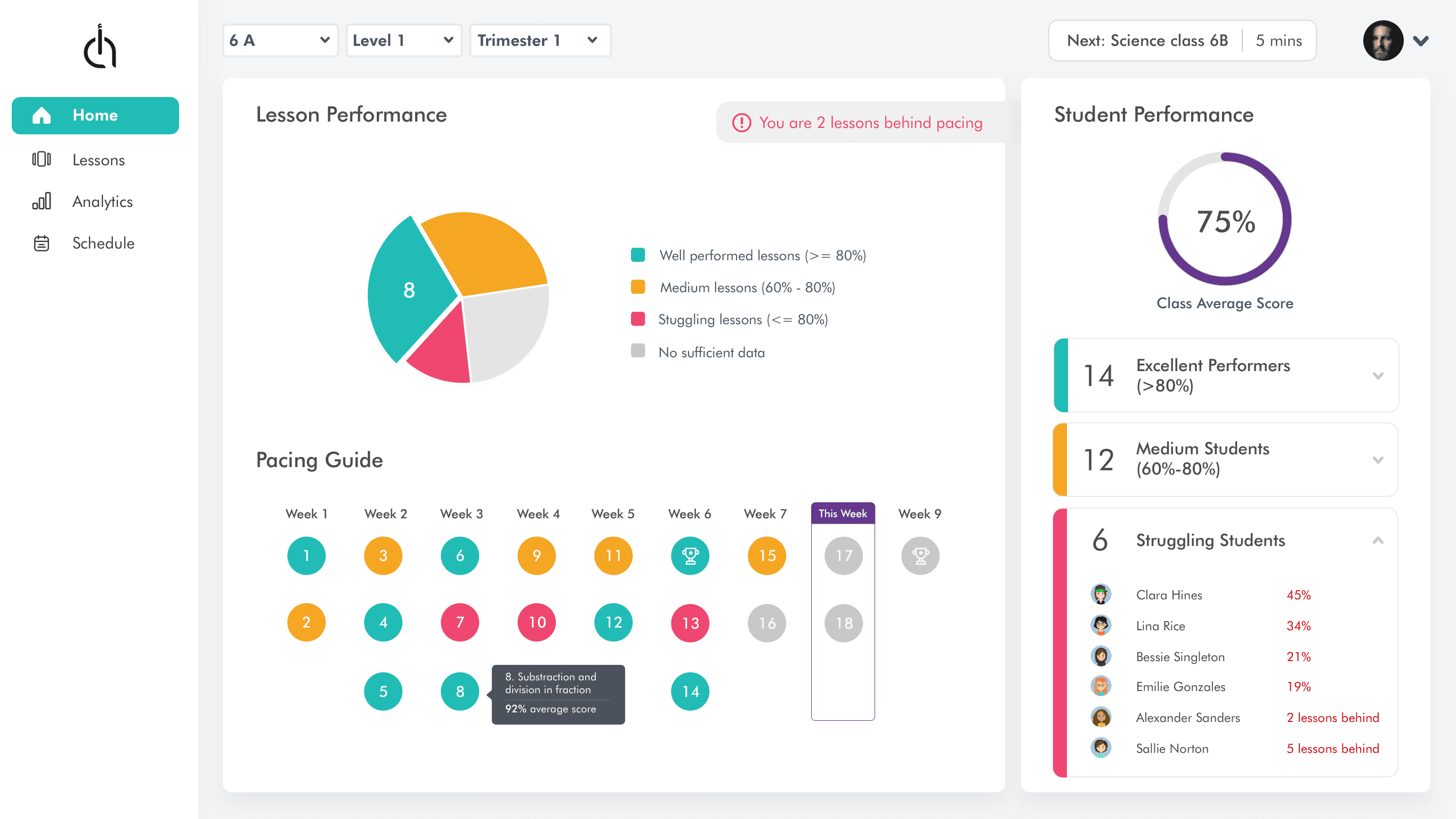
Two key dashboard views: a class-wide Progress Overview heatmap (green = mastery, yellow = progress, red = struggling, grey = not started) for instant pattern recognition, and an individual student detail view with active levels, weekly progress, diagnostics, and domain proficiency.
Alef Pathways has demonstrated significant positive impact on student learning outcomes across Math, Science, English, and Arabic:
- +12.1% improvement in final exam performance among ESSA Tier 2 students in Abu Dhabi's public education system
- +5.67% academic gain in targeted subjects, showing effectiveness in closing learning gaps through personalised, AI-driven instruction
- Increased engagement — students report greater enjoyment and independence in learning
- Better support loops — real-time progress tracking and immediate feedback help teachers and parents support students more effectively, contributing to long-term learning success